

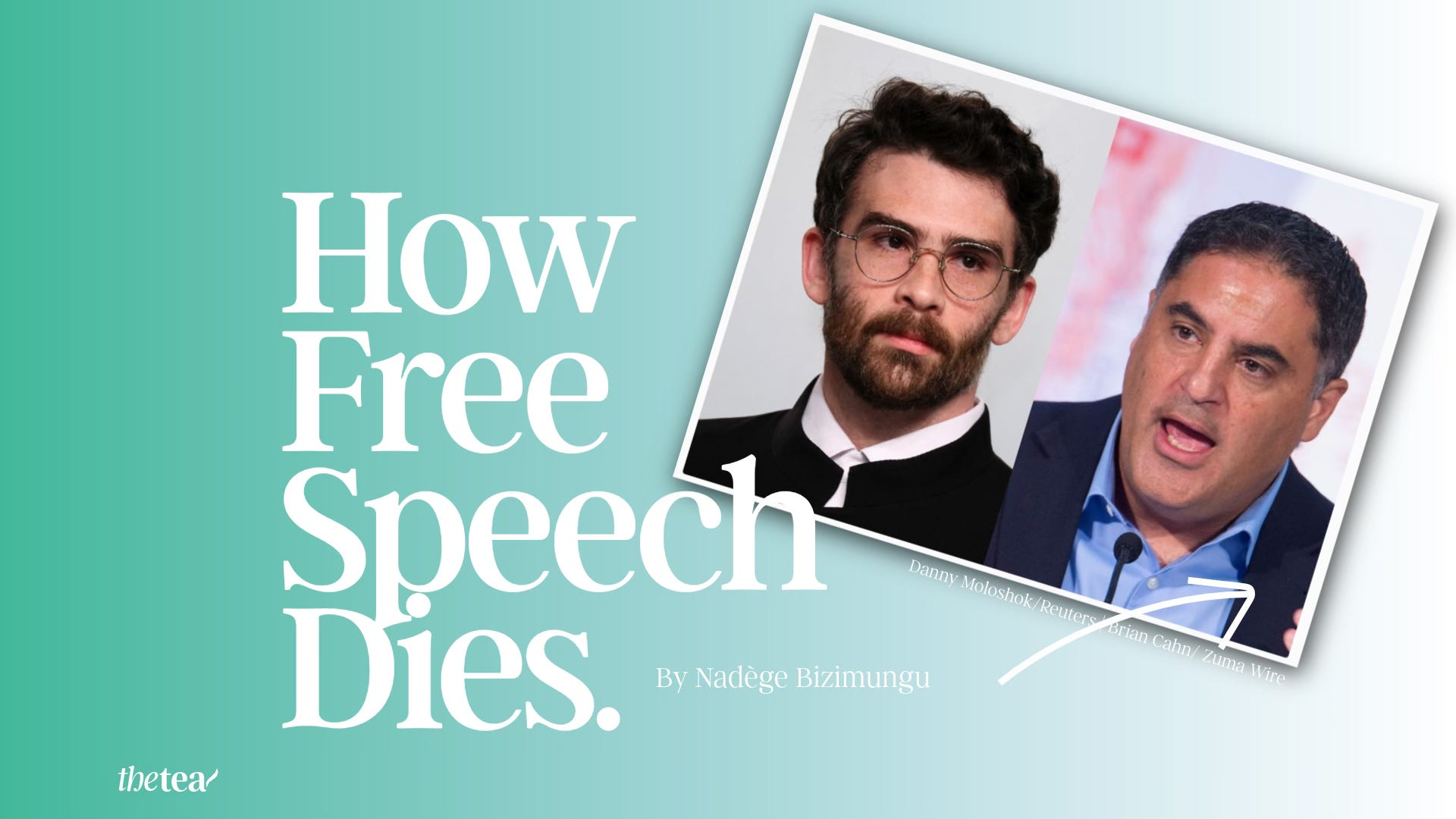
When Cenk Uygur and Hasan Piker were banned from entering Britain this week, the official language sounded almost boring. Their presence, the Home Office said, “may not be conducive to the public good”. That phrase is doing a lot of work. It turns a political decision into an administrative one, drains it of ideology, and makes the exclusion of two left-wing commentators sound like a routine matter of public safety rather than what it plainly is: another attempt to decide which forms of Pro-Palestine speech are too dangerous for the public to hear.
Uygur, the founder of The Young Turks, and his nephew Piker, one of the world’s most watched political streamers, were due to speak at SXSW London and the Oxford Union, not at some underground militia gathering. They were not accused of planning violence. They were not travelling to organise unrest. According to The Guardian, their electronic travel authorisations were cancelled after political pressure, including from Labour MP David Taylor, who had called for Piker to be prevented from speaking. Uygur said he was told he posed a “serious risk to public order” because of his criticism of Israel, including his argument that pro-Israel lobbying shapes American politics.
But what exactly is it about what Uygur and Piker have to say that is so dangerous? And how did criticism of Israel, a foreign state, become something the British government treats as a threat to public order?
Defenders of the ban will say Britain has also barred far-right figures, which is a fair argument. In April and May, the Home Office barred far-right activist Valentina Gomez and several other foreign far-right activists from entering Britain to attend Tommy Robinson’s “Unite the Kingdom” rally. But the distinction here is that Gomez is not just “controversial”. She has, among other things, called Muslims terrorists, campaigned to “kick every dirty Muslim out of Texas”, burned a Quran with a flamethrower while declaring she would “end Islam in Texas”, and was travelling to the UK to address a street movement built around anti-Muslim grievance, led by Robinsion, a convicted criminal with a record of violent engagement with the police. Other banned figures include Dutch far-right influencer Eva Vlaardingerbroek, who has promoted the Great Replacement conspiracy theory and “remigration” policies, and Dominik Tarczyński, a Polish Member of the European Parliament known for his hardline anti-immigration views.
It is fair to draw the line at organised racist mobilisation, particularly when it is attached to movements that portray minorities as an existential threat to the nation and encourage violence towards Muslims and migrants. But that is precisely why the Cenk and Hasan ban is so revealing. The state is taking a power first presented as a shield against fascistic agitation and stretching it over anti-Zionist and pro-Palestine speech. It is collapsing the distinction between inciting hatred against a minority and criticising a state committing mass violence with Western support. Once that distinction goes, there is nothing stopping the government from labelling almost any form of dissent a threat.
But contrary to popular belief, none of this is new. Historically, western democracy has always had an exception clause. It was there when colonial subjects were denied the rights Europeans claimed for themselves. It was there when anti-apartheid activists in Britain were secretly monitored by Metropolitan Police’s Special Branch, with files kept on meetings, leaflets and campaigns against South African apartheid. It was there when Nelson Mandela and the ANC were still on US terrorism watch lists until 2008, more than a decade after apartheid had ended. It was there during McCarthyism in the 1950s, when suspected communists, trade unionists, artists and political dissidents were blacklisted, surveilled and portrayed as threats to the nation rather than citizens with legitimate political demands. Most importantly, it was there during the Iraq War, when critics of an illegal invasion were smeared as unpatriotic, blacklisted, and accused of giving comfort to “America’s enemies.”
But Palestine has exposed something even more troubling. When Britain and the United States invaded Iraq, the political establishment closed ranks behind a disastrous war, but there were still powerful institutions willing to challenge it. Newspapers splashed leaked government documents across their front pages, and some outlets, including the New York Times, admitted they were wrong and exposed false claims about weapons of mass destruction. Millions of people marched in the streets and to some extent, found that at least some of their concerns were reflected in the media they consumed.
The response to Gaza has felt different. As the death toll has climbed and public opinion has shifted, much of the political and media class has remained remarkably resistant to changing course. The result is a growing sense that the argument taking place among ordinary people is not the same argument taking place inside Westminster, Washington, or many of the institutions meant to hold power to account.
But it’s important to understand that the tools now being deployed against pro-Palestine activism were not built overnight, and long before Gaza, the line between protest and extremism was already being blurred. The legal architecture was built years earlier, as governments responded to disruptive climate protests by granting police broader powers through the Police, Crime, Sentencing and Courts Act and the Public Order Act. Rights groups like Human Rights Watch have warned that these measures have resulted in arbitrary restrictions, arrests and prosecutions of peaceful protesters. In 2019, counter-terrorism police included Extinction Rebellion, a non-violent climate movement, in anti-extremism guidance alongside National Action, a banned neo-Nazi terrorist group. More recently, organisers from the climate campaign group Just Stop Oil have received prison sentences of up to five years for non-violent direct action. Once those powers and precedents were established, it was only a matter of who would be targeted next, culminating in the government’s proscription of Palestine Action.
For decades, Western governments could support Israel while claiming to represent liberal values because the contradiction was hidden behind language of “peace process, self-defence, shared democracy.” Gaza has shattered that language. The public has seen hospitals bombed, children starved, aid blocked, journalists killed, families erased, and Western governments continue to arm, defend and excuse the state responsible.
That is why Palestine is the litmus test. Not because Western democracy was ever as free or principled as it claimed, but because Gaza has stripped away the pretence. Millions have marched, organised, spoken out and demanded an end to mass slaughter. Yet governments have largely ignored them, while critics have faced censorship, surveillance, arrests and smears.
What makes this decision so significant is not simply that two pro-Palestine voices were barred from entering Britain. It is who those voices are. Uygur is one of the most prominent left-wing political commentators in the United States, with an audience of millions and a decades-long presence in mainstream political debate. If someone of that profile can be excluded for his views on Israel, the bar has moved. What was once presented as an exceptional power reserved for extremists is now being applied to figures operating squarely within democratic political discourse.
The lesson, then, is not that Britain is suddenly becoming authoritarian. The lesson is harsher: the machinery was already there, waiting for the right cause to justify its use. Palestine has exposed where the boundaries of permissible speech really lie, which freedoms are real, which are conditional, and how quickly they can disappear when they challenge power
.