

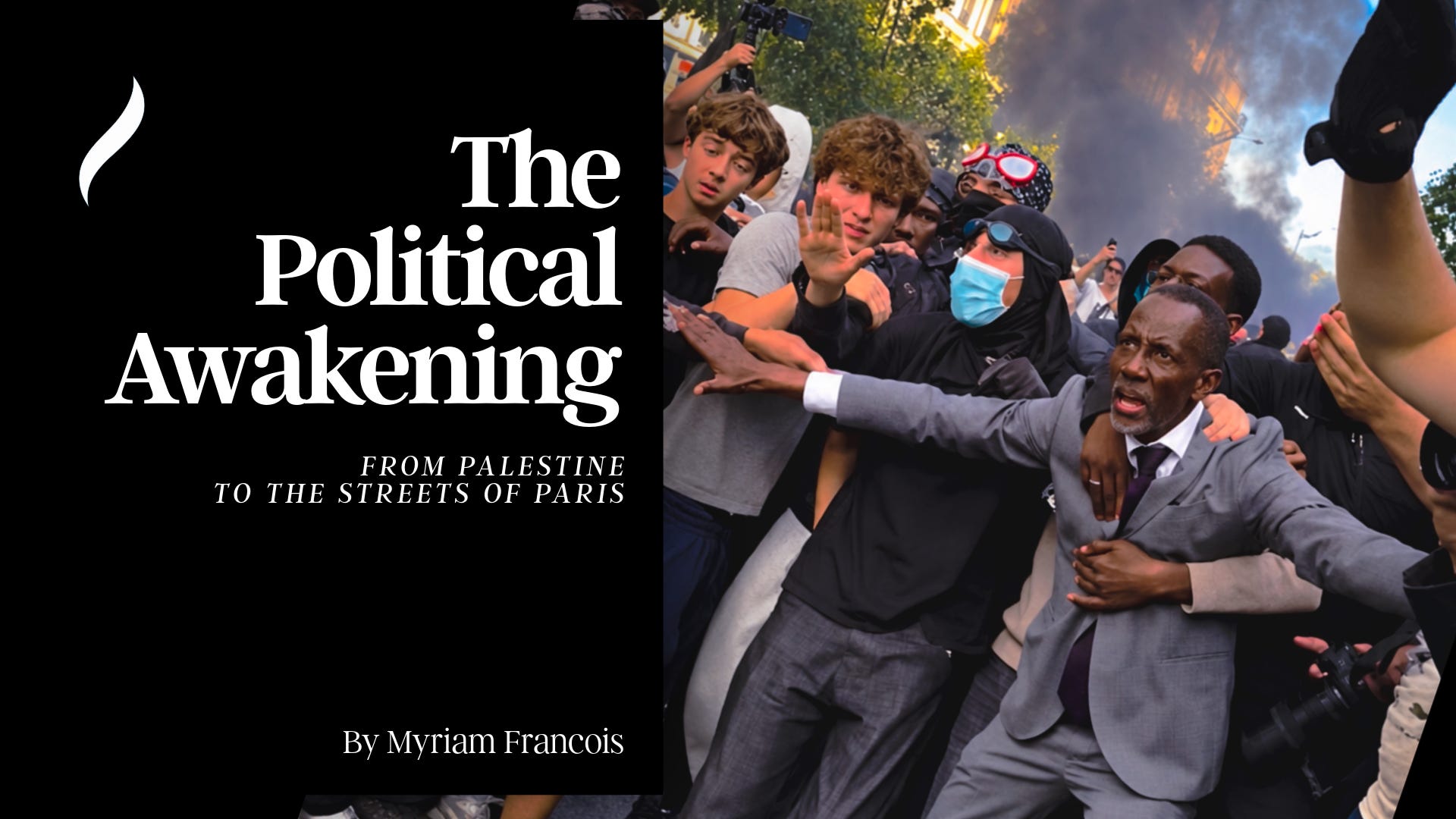
If you follow me on social media, it will come as no surprise that I’m dedicating this week’s newsletter to the French protests, which are unfolding against a backdrop of unrest across the world: in Spain over rents, in Germany over the draft, anti-fascists marches in Brasil, the cockroach movement in India, in the UK over the proscription of Palestine Action, through to New York, where another ICE shooting, this time of a father in front of his five-year-old child, has once again sparked public fury. And all of this against the wider pan European protests from Turin to Dublin which occurred this weekend, including over 250,000 marching through London against the ongoing genocide in Gaza. Throughout all these protests, over different social and economic issues, in countries separated by thousands of miles, by language and culture, one common symbol can be found throughout, as conspicuous today as as the peace flag was to another generation: the palestinian flag.
Symbols of Palestinian solidarity run as a guiding thread through all these protests and it should come as no surprise. Palestine today has come to represent not only the legitimate struggle of the Palestinian people for freedom and statehood, but a galvanising symbol of resistance to oppression, a nod the David vs Goliath struggles of the people against militarised repression, surveillance and state violence, and a recognition of the convergence of struggles for human dignity and liberation.
But the dots don’t connect only at the symbolic level of the keffiyeh or the Palestinian flag.
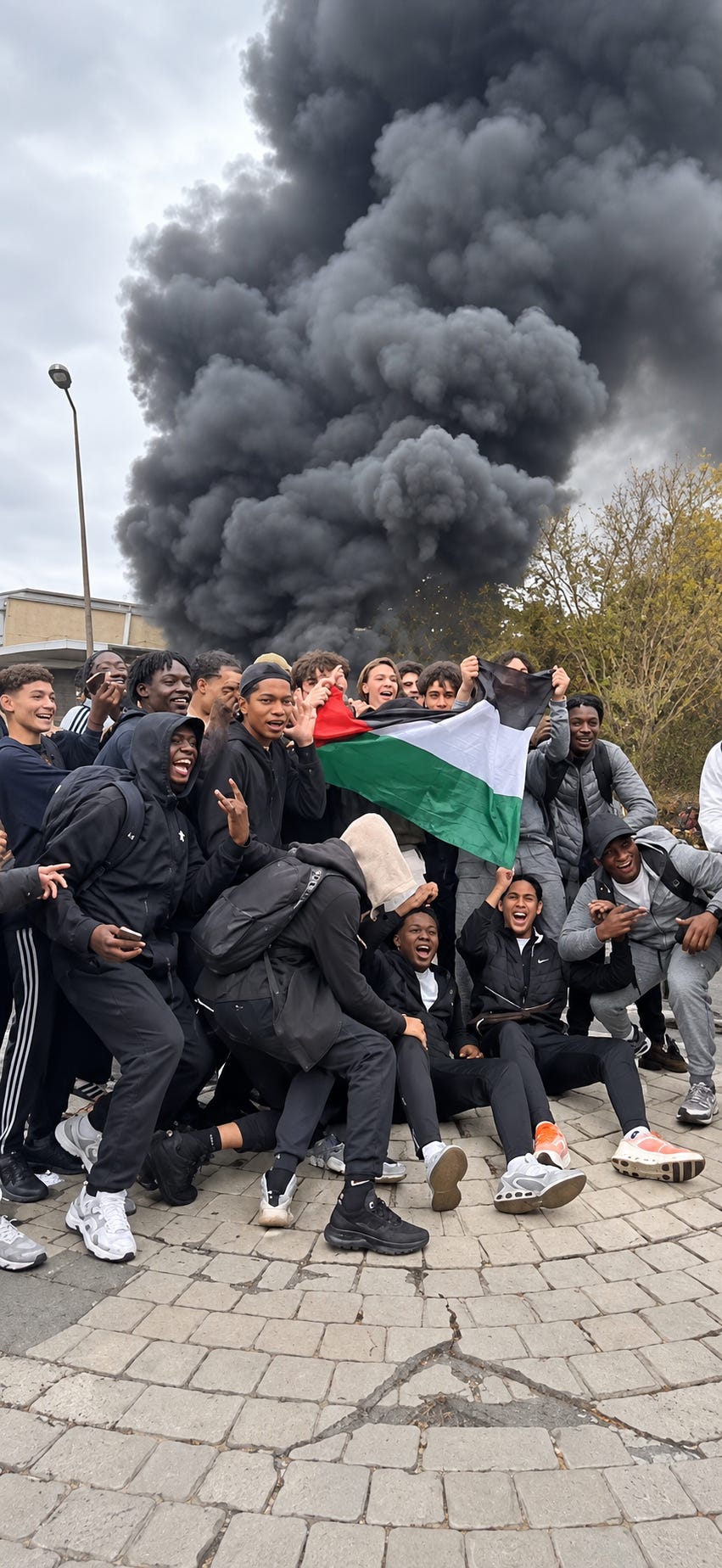
The images of violence coming out of France have felt eerily familiar - the violence against terrorised children. A militarised police force facing off with unarmed civilians. Children being shot and losing limbs and eyes. Sexual assault. The disconnect between our social media feeds and the news. The gaslighting of protestors in interviews. The seeming impunity of officers boasting about causing harm caught on camera or using racist language without apparent fear of sanction. Many of the images were triggering reminders of just how close we all are to the types of violence we have watched unleashed on the occupied Palestinians for decades, but also in recent years, on protestors standing in solidarity with them at Columbia university or protestors on the streets of Germany and beyond.
But it isn’t just the state violence which has reinforced these parallels. There has also been the gap - the chasm even, between official public discourse, from politicians and legacy media around the french protestors, presenting them as dangerous and feral, and the reality on the ground of young people demanding dignity and equal rights. The students message has been simple and clear throughout: our schools are understaffed, under equipped and dilapidated, compromising our health and our ability to achieve equal educational outcomes to students in wealthier areas.
For its part, the French government initially referred to the protests as “urban unrest”, and the media focused heavily on images of sporadic clashes, rather than on the young people at the heart of these events, framing them instead as ‘public-order’ problem rather than a political or social crisis.
This media focus on isolated incidents of violence fulled inane debates about immigration and lawlessness, which sought to situate the source of the unrest in the racial background of some protestors, rather than on their underlying grievances.
In a pattern reminiscient of the upside down coverage which characterised the genocide, the gap between the abysmal news from billionaire bought legacy media outlets contrasted starkly with Palestinian journalists, as well as so-called ‘citizen journalists’, documenting their realities on the ground, betraying an editorial misrepresentation of facts which provided the ideological cover for official government posturing. In France today, over 80% of France’s national daily press, major private television channels, and news radio networks are controlled by roughly nine French billionaires and industrial groups.
The resurgence of this gap has reinforced the sense of parallel struggles, and confirmed the growing lack of trust in legacy media outlets, whose function is meant to be to act with distance and necessary accountability of power, as the fifth column of our democracies, not as its mouthpiece. Instead, young people who described living through a ‘war’ on their streets, were treated as violent instigators of the harm they were experiencing.
Where the Palestinians have long been depicted as ‘violent muslims extremists’ (despite many not even being muslim..), the french working class in urban suburbs has seen similar propaganda techniques used to represent them as foreign, immigrant and dangerous, fuelling decades of far right fodder which shifted public debates away from very concrete social and economic issues of inequality toward the increasingly normalised Far-Right idea of the ‘great replacement’, that immigrant populations are being ‘used’ to replace the ‘native’ populations of Europe. It’s an idea which while officially critiqued by Macron and his government, has found new expression in the term ‘ensauvagement’ or ‘Savage-ification” which many critics say carries similar connotations and has been used to describe the recent protests. These were not students bolstering teacher demands for decent working conditions in education, both the government and media chimed, they were unruly ‘savages’ who needed to be put down by ‘any means necessary’, the very ‘carte blanche’ which the minister of interior gave to the police in his instructions on how to deal with the students. And free reign was exactly what was unleashed on France’s children.
Videos circulating online show violent masked officers refusing to give their ID numbers, despite this being required by law, using racist or sexist language, one clip shows an officer strangling a 14-year-old girl as she cries in pain; a 14-year-old boy shot in the face at close range, shattering his jaw; an officer allegedly boasts of having blinded students with his launcher, a boy is held underwater by an officer who believes he is out of sight, one boy claims he was shot in the arms and has lost his hand, and a teenager is tasered in the face as he walks away peacefully. These are just a snapshot of the violence France’s children have received as a response to a call for better educational facilities.
The CRS police have a long history of excessive violence, and in the poorer suburbs their impunity and lack of accountability are widely understood features of a police force whose role is not to protect people but to ‘maintain law and order’. French police have been linked to the suspicious deaths in custody and assaults of a litany of predominantly Black and brown men, whose families continue to seek justice to this day. And today, France is among a small number of European countries whose police routinely deploy LBDs — often known by the older name “flashball” — as well as sting-ball grenades and other lethal weapons. Human rights reports have documented severe, life-altering and sometimes fatal injuries caused by LBDs. These lethal weapons, or ‘weapons of war’ as one politician called them, are capable of maiming and even killing and recent weeks have seen serious life altering injuries meted out to France’s kids.
To add insult to literal injury, the French parliament is currently considering a law that would grant police further impunity by establishing an automatic presumption of self-defence for officers. If an officer uses force or fires a weapon on duty, the law would treat them as having acted lawfully and in self-defence, shifting the burden onto victims to prove otherwise. Given the images we have seen in recent weeks, it is easy to see why many are outraged.
Just as throughout the Gaza genocide, the TV said one thing, while our phones showed another, throughout the french protests, Snapchat, TikTok and Instagram revealed a reality on the ground which challenged the official narrative. These clips did not show violent anger, for the most party they showed a highly politicised, humorous generation of teenagers with moral clarity about the issues affecting them, laying bare the impact of budget cuts on public services.
In true Gen Z tradition, and as seen in protests across the world, young people used viral trends to mock and turn to derision attempts to present them as either feckless, naive or violent. Even before this wave of protests, students were using the ‘of course’ trend where creators make self aware statements about themselves, to highlight their broken ceilings, lack of desks, flooded and freezing classrooms, “I’m a student in the ‘93 (poor neighbourhood) - of course we have rats running down our corridors”. But other trends were now being used to mock power more directly. A teen in a unicorn costume dances in front of a wall of armed and angry officers. Another does the shoot dance from fortnite on the backdrop of a barrage of armed officers with shields and helmets. An influencer films her makeup tutorial in the midst of the chaos, telling officers they are ruining her shot, or the use of the ‘Who’s Most Likely To” trend, typically done between a couple or friends, where protestors ask a hapless officer ‘who’s the jealous one’ as he stands ominously over a 15 year old in stitches. Their slogans too speak to a generation wide awake and steeped in the culture of irony. Their politically astute placards stand as flippant rebukes of the widely circulated claim the students are naive puppets of left wing political machinations— “35 per classroom, but the issue is the headscarf”; “Too young to vote, but young enough to be gassed”; “The state is pissing on us and the media tells us it’s raining”; or my personal favourite, “Only trash cries over burnt bins”. One slogan “Bismillah, c’est les ténèbres” roughly translated “In the name of God, it’s darkness / pure chaos” has become a core satirical meme and rally cry after the phrase originated from leaked screenshots of Snapchat and WhatsApp organizing groups where police officers allegedly tried to pose as Muslim students in order to gather intelligence on upcoming blockades. It now features in rap tracks, on major banners and in a litany of viral videos mocking the police for their on the nose tactics.
But the social media resistance didn’t stop at mocking power - it also involved reshaping their own narrative beyond the headlines. Young began filming themselves and their speeches, referencing French revolutionary history or philosophers to denounce an inequality they had been raised to believe was antithetical, at least in principle, to the foundational values of the country of ‘liberty, equality and fraternity’. These viral speeches challenged the narrative the teens were being politically manipulated, instead betraying a profound understanding of not only Republican values, but of the disconnect between the promises of the republic and their lived realities.
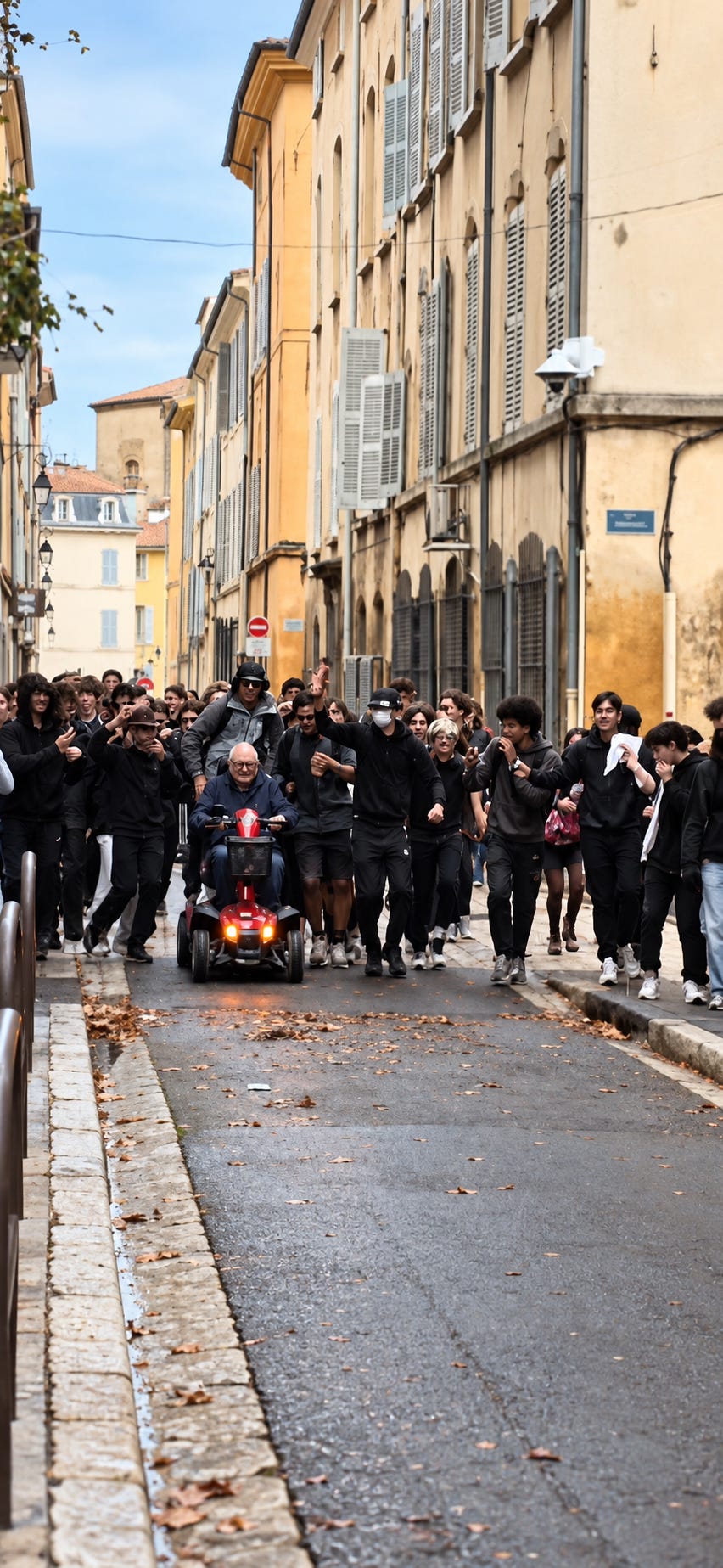
Just as the convergence of struggles also began to be represented in the Palestine solidarity movement through the presence of the Black, LGBTQ+, feminist and other groups alongside Palestinians, here too, social media began to show us scenes which fundamentally challenged the far-right’s grip on legacy media characterisation of the suburbs, as somehow in conflict with the wider French population. Many older people, generations long cast as afraid or opposed to the diversity of the youth, came out to support the teens, saying they had lived through the iconic french student protests of May 1968, the last major youth protest of this scale, or simply admired the young people and wanted to back their cause. One iconic clip showed an elderly white man on his mobility scooter, accompanied by a cheering group of masked, diverse young men in tracksuits riding on the back, gleefully leading them through the streets of Paris, very clearly living his best life. Others showed young people trying to usher elderly people struggling to breath due to the tear gas being ushered to safety or simply handing out hugs.
Despite the media bias, polls show that nearly three in four French people, consider the students’ demands legitimate, a picture of national unity which fundamentally challenges the divisions along racial lines which both the Right and Far Right, as well as much of the media has represented as France’s primary faultlines. Instead, the diverse youth of the new french republic are seen chanting the national anthem, waving the french flag and quoting 17th-century French playwright Pierre Corneille, as they embody the values of the very Republic they were told they rejected. This harnessing of the symbols of the republic has seen the young people rally a wide breadth of French society, from firefighters to nurses, as well as the Gilets Jaunes and farmers who have previously led their own nationwide protests movements, forming one of the largest movements in modern French history. These historic gatherings of hundreds of thousands have also been used to reassert ownership of the values and history of the Republic, as young people affirm not only their grasp on French revolutionary history but on their right to reimagine its principles in opposition to power. Paris’s Place de la Bastille is for example a site that carries the memory of the 1789 Revolution, when the people gathered before they stormed the Bastille prison and the Palace after the elites famously (although perhaps not accurately) told the starving people “Let them eat cake.”
As France battles its students over desks and toilet paper, a leaked report suggests anywhere between 13,000 and 50,000 millionaires in France don’t pay any tax on their income, while a single state dinner held at the Palace of Versailles for King Charles III cost €474,851.
After nearly a decade in power, President Macron has presided over the neoliberal gutting of many of the social structures so many French people are profoundly proud of. Once known for its rigorous academic standards and comprehensive curriculum, French education has seen more than 4,000 teaching posts slated for cuts in 2026 alone, alongside deep pressure on the education budget, pressures that have fallen unequally on secondary schools in poorer neighbourhoods.
Just as the elites in French school textbooks ignored the population starving at their gates and instead sought to unleash violent repression, the young people studying that history today are not blind to the parallels, nor the lessons internalised by all French people, the right of the people to confront power where it fails to heed them.
Despite some concessions emerging, such as 3000 teachers being allocated to cover the problem of absentee teachers, violence has continued to be the dominant response to the republic’s children.
There have been over 6,877 arrests and police custodies since the movement began, according to the French Justice Ministry — 86 per cent of them minors, meaning 14 to 17years old. Some young people were reportedly identified and picked up from home using facial-recognition technology, and there are reports of further abuse in police cells. For some sense of scale, there have been proportionally more arrests in recent weeks than during comparable large protests such as the Gilets Jaunes movement in 2018, when hundreds of thousands took to the streets over fuel-tax rises and around 10,000 people were arrested over the course of an entire year.
For its part, the government has been conspicuously absent from the street, despite ministers meeting with protesters at other major demonstrations. While Macron has focused on law and order, calls for the resignation of the education minister, as well as Prime Minister Sébastien Lecornu, have become central demands, in the face of what many regard as an institutional insult not only to children, but to the very values of the Republic they have come to embody.
Here again, the echos of the Palestine movement are plain to see. This generation’s political awakening has occurred against the backdrop of the cognitive dissonance between western proclaimed values of human rights and international law and the decisions by many European governments to continue to trade with, sell weapons to and even welcome Netenyahu on European soil throughout the genocide. That disillusionment has now carried over to other struggles, where there seems to be a growing recognition that the people themselves are going to be required to embody the values the governments have seemingly abandoned. And where the symbol of the keffiyeh takes its full meaning.
What governments seem to be awakening to far too slowly, is that once people no longer believe the social contract in a democracy exists, and this has been in question for a long time, the rules of political engagement shift too. People will only rely on the ballot box if they believe it can effect change and the growing movement of street politics in recent years suggests that connection is already broken. If in addition to that, public protests become sites of inherent violent confrontation with government forces, then the legitimacy of the reigning order itself begins to crumble.
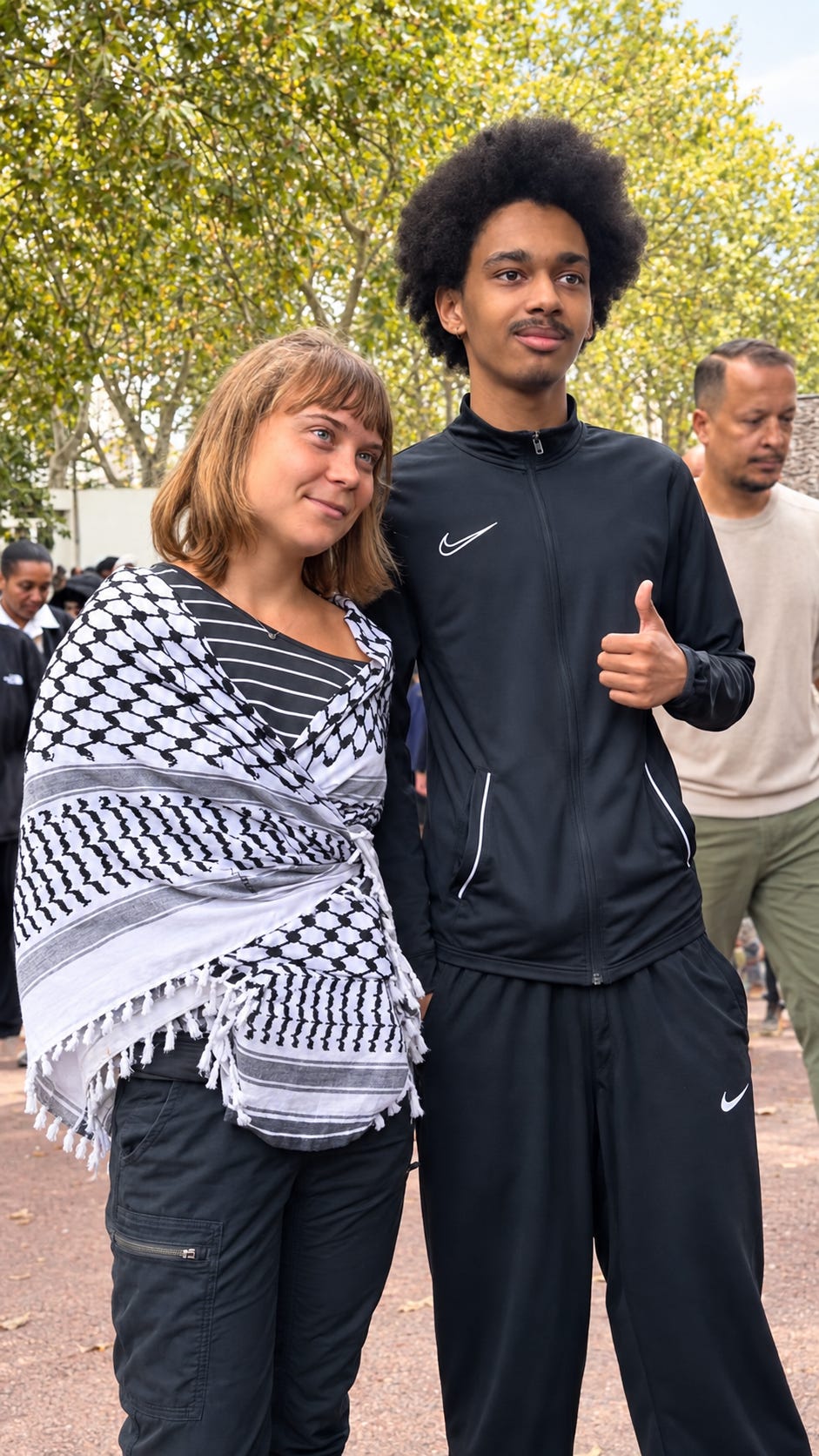
What’s striking in the French protests is that the evidence of the broken political contract now spans class and even political allegiance. While the protests began in the poorer suburbs, wealthier central Paris schools, including the highly selective Lycée Henri-IV, have joined in solidarity, followed by universities, including some of France’s most conservative institutions, long immune to protest and typically linked to the political right, such as Catholic universities and elite engineering schools. It also convened social classes across class cleavages, with lawyers and professors joining the nurses, teachers and other frontline staff who’d already come out in support of the students. And with the recent arrival of Greta Thunberg in her keffiyeh, it has arguably now gone international.
As with Palestine, the sites of protest are also dissolving false binaries. In the same way that the antisemitic charge was harder to uphold when so many Jewish people were front and centre of the marches for Palestine, or representation of the Palestinian cause as as fringe arab or muslim issue dissolved in the face of so many white families marching, here too the marches have challenged the Far right/ Right’s claim of a society divided primarily along racial lines. Instead, what has emerged is the unifying power of democratic, republican values, where the principles and ideals of marching citizens are recognised as their primary marker of solidarity, over and above the racial lines previously drawn and consistently reinforced as most salient. Arguably there is nothing frencher than what these students, many of diverse backgrounds, are doing right now in asserting their rights as republican citizens and this fundamentally challenges the Far Right’s grip on the story of the nation and the roots of its decay.
As with Palestine, the shift is visible and palpable, but what happens with this energy is the question many are asking. Where to from here?
On October 17th, a massive nation wide protests is planned which will coalesce the struggles of multiple sectors - one activist told French tv the plan was to block the roads, the ports and gas stations, that 30% of police officers would call in sick in the South and firefighters are also alleged to be joining. If he’s right, the 17th of October which also commemorates one of the deadliest state-sanctioned massacres in modern Western European history, known as the 1961 Paris Massacre, in which hundreds of Algerian protestors were murdered, many drowned in the Seine, is likely to be a day of protest of historic proportions.
Governments around the world are on high alert as they observe a coalescing of groups and forces previously pitted against one another. Many have also learned the lessons of previous failed movements. Gilet Jaunes activists have provided a sobering reminder that despite a year of disruptions on their end, and some limited concessions, including scrapping the then proposed increase on eco-taxes, which was the original catalyst for the protests, an increase of minimum wage and repealing a scheduled tax increase on pensions, other demands which spoke to more profound institutional reforms to the democratic process and a return of the wealth tax were ignored. The question for those who take to the streets on the 17th will be what exactly these coalesced demands are and who will be authorised to negotiate them.
Vincent Bevins, our guest this week on the show, is a journalist whose recent book “If We Burn: The Mass Protest Decade and the Missing Revolution”, looks at why a historic surge of mass, leaderless protest movements across the globe ultimately failed to achieve their goals, or worse, produced results opposite to what demonstrators intended. We hope it will spark useful conversations on the ‘where to from here’ question which this moment poses from Paris to Berlin, Rio de Janeiro and beyond.
The Palestine solidarity movement, far from being solely about the liberation of Palestine, has come to represent the convergence of struggles: the right to dignity and resistance for all, and a reminder of the fundamental unity of people’s basic aspirations. But as people rise up around the world, the question must today be how to turn people power in the streets, into people power in government and crucially, how to avoid these moments being hijacked by those who’ve considered these questions most ardently and been preparing in the shadows to seize this opportunity. Power to the people always.
A brilliant reflection on the unification of past and present to charge forward at last as one towards what is very much an uncertain future for all. The orwellian stifling of protest has started to break free from the shackles and soon we might see the mercury bubbles connect as adjacent nations rise together. This is not just a time of change in world order, it is the time the youth representing the future took back control of their indomitable right to have their time.
Superb, passionate, cross-cultural analysis that beautifully connects the youth struggle in France with the international solidarity against the Gazan genocide, and with the Palestinians. It's also a powerful explanatory gloss on how in the U.S. the university youth in their valiant and non-violent protests against the genocide, which met with similar attacks sanctioned by their own universities, have galvanized, despite the vicious repression, the truly vibrant progressive movement against Trump's fascism today.