

A Jewish mass movement that rejected the idea of a Jewish state ever existing was, for much of its history, more popular than Zionism. Here’s why almost nobody has heard of it.
Poland in the 1930s had the largest Jewish population in Europe, and the single most popular party among Jewish voters there wasn’t Zionist. It didn’t want a Jewish state at all.
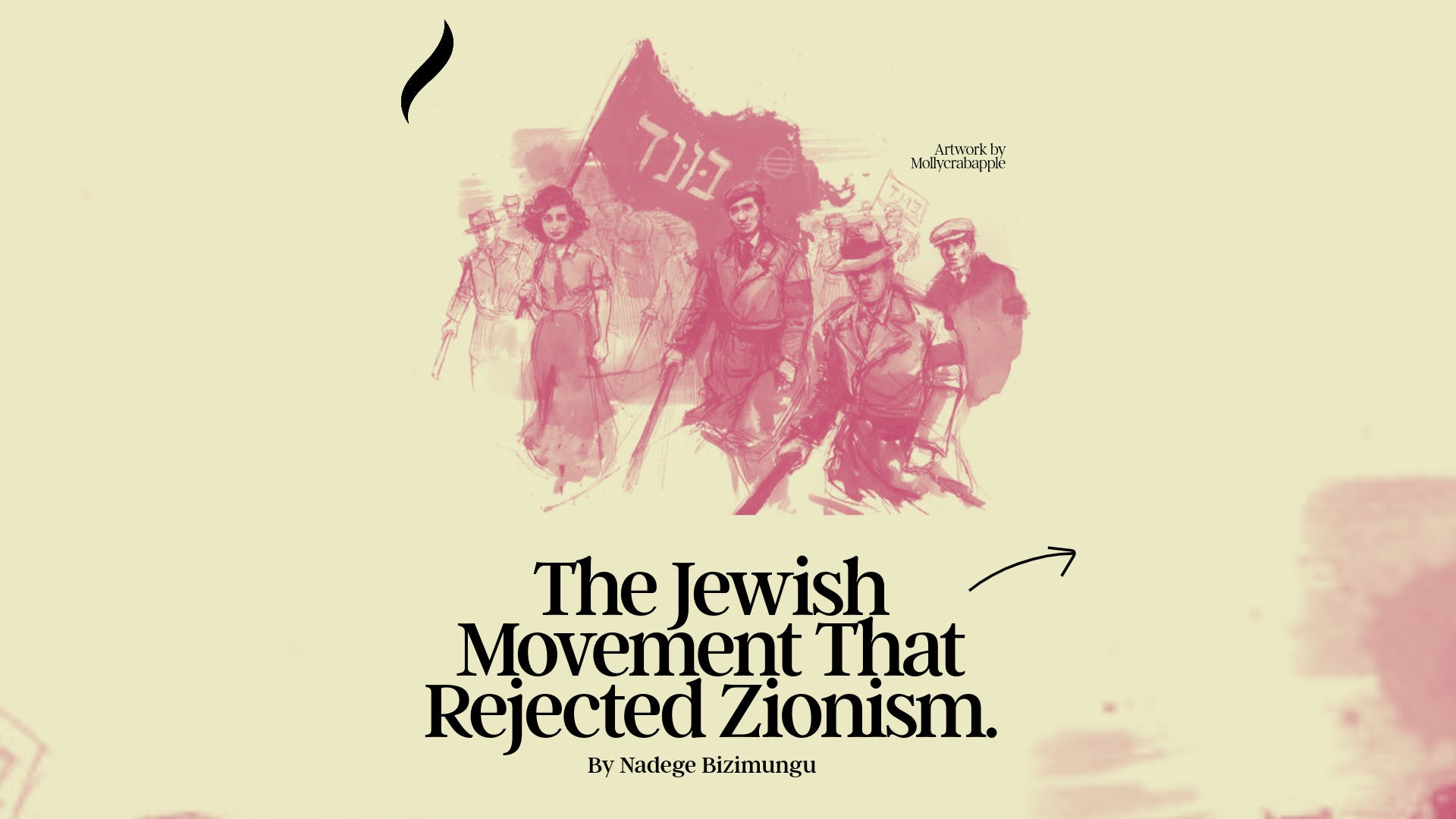
It ran schools, published newspapers and even organized armed militias to defend Jewish communities. According to an analysis of Bund election results published in the Yiddish studies journal In geveb, the party won roughly 38 percent of the vote for Jewish parties in the last Polish municipal elections before the war, more than any single Zionist party, though the combined Zionist lists narrowly edged it out overall. Its members were fiercely opposed to Zionism and thought it was a fantasy, and they said so bluntly and often.
That party was the Jewish Labour Bund. Today, few people know its name, but at its peak it was one of the most important Jewish political movements in Europe. Its existence challenges a common idea about Jewish history: that Zionism was the only response to antisemitism. For decades, millions of Jews supported a different vision. They believed the answer was not a new country, but fighting for equality where Jews already lived.
The Bund was founded in October 1897, when thirteen young Jewish Marxists met secretly in an attic in Vilna, then part of the Russian Empire. That’s the same year Theodor Herzl convened the first Zionist Congress in Basel. Zionism argued that Jewish safety required leaving Europe and building a state. The Bund argued the opposite: stay, and fight for equality where Jews already lived, in solidarity with non-Jewish workers and socialist movements. The Yiddish word for this was doikayt, “hereness,” and it rejected the idea that Jewish life needed a single homeland at all.
The party grew fast, and contemporaries noticed. The Menshevik theorist Georgi Plekhanov reportedly called Jewish workers “the vanguard of the labor army in Russia.” Historian Bertram Wolfe later described the Bund as the largest and best organized body of workingmen inside the Russian empire. By 1906 its membership had reportedly reached around 40,000, briefly making it the biggest socialist organization in the empire, and by interwar Poland it had built an entire subculture: youth movements, sports clubs, a network of secular Yiddish schools. Jack Jacobs’s research on the interwar Bund treats it as a genuine mass institution, not a fringe faction.
None of this was naive pacifism. Bund militias organized armed self-defense against pogroms and antisemitic gangs on the streets of interwar Warsaw, decades before “Jewish strength” became coded as an Israeli idea. When the Nazis invaded, Bundists fought in the 1943 Warsaw Ghetto Uprising, the first urban revolt against Nazi occupation anywhere in Europe. One of its fighters, a Bundist teenager named Lusiek Blones, was thirteen years old.
The rivalry between Bundists and Zionists ran deep, and it was rooted in a real disagreement about what antisemitism demanded of Jews. Bundists argued that if European governments were insisting Jews were foreign and should leave, then Zionism, by proposing that Jews do exactly that, was conceding the antisemites’ premise rather than refuting it. Zionists saw it differently: as a response to the repeated failure of emancipation and assimilation to protect Jews anywhere in the diaspora. After the 1917 Balfour Declaration, in which Britain backed a Jewish “national home” in Palestine, Bundists increasingly viewed Zionism as bound up with imperial power rather than freed from it, a colonial project underwritten by the same empires that had failed to protect Jews in the first place.
The Bund wasn’t beaten in that argument, though. It was murdered. The Holocaust wiped out the working-class Jewish communities that had sustained the party for half a century. Historian David Slucki has documented how the postwar Bund never came close to rebuilding its prewar scale, plateauing at just a few thousand members worldwide by the late 1950s. Daniel Blatman’s research on the Bund’s final years in Poland, from 1939 to 1949, traces a parallel political defeat: Stalinist repression, including the 1942 murder of Bundist leaders Henryk Erlich and Victor Alter by Soviet secret police, finished what the Nazis had started.
Zionist institutions in Palestine, meanwhile, survived the war intact. In her new book, Here Where We Live Is Our Country, artist and journalist Molly Crabapple, whose account of the Bund this piece draws heavily on, argues that Zionist organizations controlled much of the rations, housing, and paperwork in the displaced-persons camps after the war, and used that leverage to funnel traumatized survivors toward Palestine. A movement with no population left to organize couldn’t compete with one that still had territory, infrastructure, and international backing behind it.
That imbalance is also why the Bund disappeared from memory rather than from relevance. It lost its people, not its argument, and a movement without survivors to carry its institutions forward simply stops being written about, no matter how large it once was.
The premise Zionism was built on, that Jewish safety requires a Jewish ethnostate, is now facing its sharpest public challenge in decades. Nearly three years into Israel’s war on Gaza, which the UN and earlier findings from Amnesty International and the International Association of Genocide Scholars, have described as genocide, support for Israel has fallen sharply, including among Jews themselves. Younger American Jews are significantly less likely than older generations to see support for Israel as central to Jewish identity, while nearly half of American Jews under 35 now say they would support a single binational state with equal rights for Israelis and Palestinians. In Britain, young Jews who identify as anti-Zionist or non-Zionist now roughly match those who identify as Zionist.Israeli historian Ilan Pappé, a longtime critic of his own government, has called this the “beginning of the end of the Zionist project,” pointing to internal political fracture, international isolation, and economic strain as evidence.
For Crabapple, this shift is also personal. She spent seven years writing Here Where We Live Is Our Country, much of it while Israel’s campaign in Gaza was underway. in an interview on Democracy Now!, she said there was something almost unbearable about reconstructing the destruction of Warsaw’s Jews while watching a country invoke the Holocaust to justify what was happening in Gaza. “It broke me,” she said, “in probably ways that I have difficulty expressing.”
What this history suggests, isn’t a clean answer to the hardest questions about what a just political future looks like after decades of occupation and violence. It’s something narrower, and maybe more useful: proof that at the exact moment Jewish nationalism was taking shape, a mass, organized, genuinely popular Jewish movement existed that rejected the idea that Jewish liberation had to come at another people’s dispossession. It didn’t lose that argument. It was destroyed by fascism, the Holocaust, and Stalinist repression, and its ideas went down with it, not because they were wrong, but because there was no one left alive to keep making the case.
I loved the interview of Molly Crabapple on *The Tea*; great work by Ms. Francois. Another great interview with Molly can be seen on Al Jazeera, conducted by Marc Lamont Hill. Well worth watching both!
The interview with Molly Crabapple was beautiful. Thank you.