

Why a new media bill, a fast-tracked terrorism law, and an EU court ruling are all worrying signs of a growing encroachment into what information we are allowed to access.
Is some information just too dangerous for the public to have access to it? Do you believe you need a government intermediary to help you make sense of information? These questions are not as easily answered as they may seem. We are living through the age of disinformation - the deliberate attempt to lead people to believe things which are not true, just as we are also living through the age of misinformation, the non deliberate spread of falsities. In its flagship Global Risks Report, which pools research from over 1,300 global experts and policymakers, the World Economic Forum consistently identifies misinformation and disinformation as the single most critical short-term threat facing the world, ranking them higher than extreme weather events, interstate armed conflict, inflation, or economic downturns.
A 2026 Reuters study found that global trust in information has dropped to its lowest level since tracking began in 2015 with on average, only 37% of people globally state they trust the news they consume. 62% of global respondents explicitly state they are deeply concerned about their ability to separate real information from fake news on social platforms and trust in information pulled directly from social media platforms sits at an abysmal 22%. The question is, do we trust governments and institutions to be the ones separating fact from fiction and what are the risks of putting our trust in increasingly authoritarian and far right governments to promote accurate information, over propaganda. The stakes are incredibly high - not least our very ability to discern reality, to make sense of the world and to organise effectively in response to it.
Twenty years ago, if you wanted to learn something, you walked into a library. You might have trusted a librarian to make some recommendations, but you could access a shelf of books on the topic at hand. You knew exactly where the information came from.
Then came the internet: a wild, sprawling reading room with no librarian and lots of grifters posing as informed bloggers. Still the range of search engines, from Mozilla to DuckDuckGo to Google meant you could access a very wide - possibly somewhat intimidating range of sources, even if many of these were culture and language specific (we were definitely not being recommended Arabic literature or Chinese intellectuals). Then AI search came along and promised to make our life easier by chewing our food for us. We could just ask a question and a magical, factual answer would emerge, already thought out and synthesized. Only that’s not quite so.
A major BBC investigation found something troubling: AI search engines routinely lean on flimsy, circular, or even fully invented references to back their claims. A Stanford study, working independently, landed on the same number: only 50 to 60 percent of sentences produced by AI search tools are actually backed by the citations attached to them. Roughly one in ten citations is pure fiction — a web page that was never built, a paper that was never written, digital hallucinations.
That should worry you on its own because so many of us are using AI search engines as short cuts for research. While they can certainly aid research - they cannot DO the research. As a team which researches our shows extensively, I can assure you of that.
But this access to increasingly normalised misinformation, is even worse when you consider the facts in context.
State-sponsored information warfare has scaled from a fringe intelligence tactic into an industrialized, multi-billion-dollar line item in national budgets. The Oxford Internet Institute documented private marketing and PR firms operating in at least 48 countries executing computational manipulation on behalf of political and state actors. They identified at least $60 million spent explicitly on hiring these private firms for coordinated social media manipulation and designated manipulation of public opinion through social media, a growing threat to democracies around the world.
While your attention span shrinks (thank you, TikTok) and our trust in the tidy “rounded-up summary” grows, the wealthiest people on the planet are quietly concentrating political and economic power, a key indicator in the social sciences of authoritarian control. And as they do, they keep a growing number struggling to achieve the basics so we have no time to look up at those eroding our democracies that make a heist on public assets.
The World Inequality Lab, co-directed by Thomas Piketty, tracked a structural shift since the 1980s: nations have grown richer, but governments have grown poorer. Net public wealth — what the state owns minus what it owes — now sits near zero or negative across most major Western economies, the UK and US included. Nearly all the wealth created in the last forty years went to the private sector, disproportionately its top 1 percent. The same 1 percent who own the platforms people now rely on to make sense of any of this. Are you seeing the issue yet…?
And now governments want a say in what should appears on our feeds. Nanny state to the rescue. Or is it? With all we know of naked corruption, the growing gap between public needs/opinion and political decision making, the rise of fascism globally, Im not certain we can trust the government or any current supranational institution to chew our food for us.
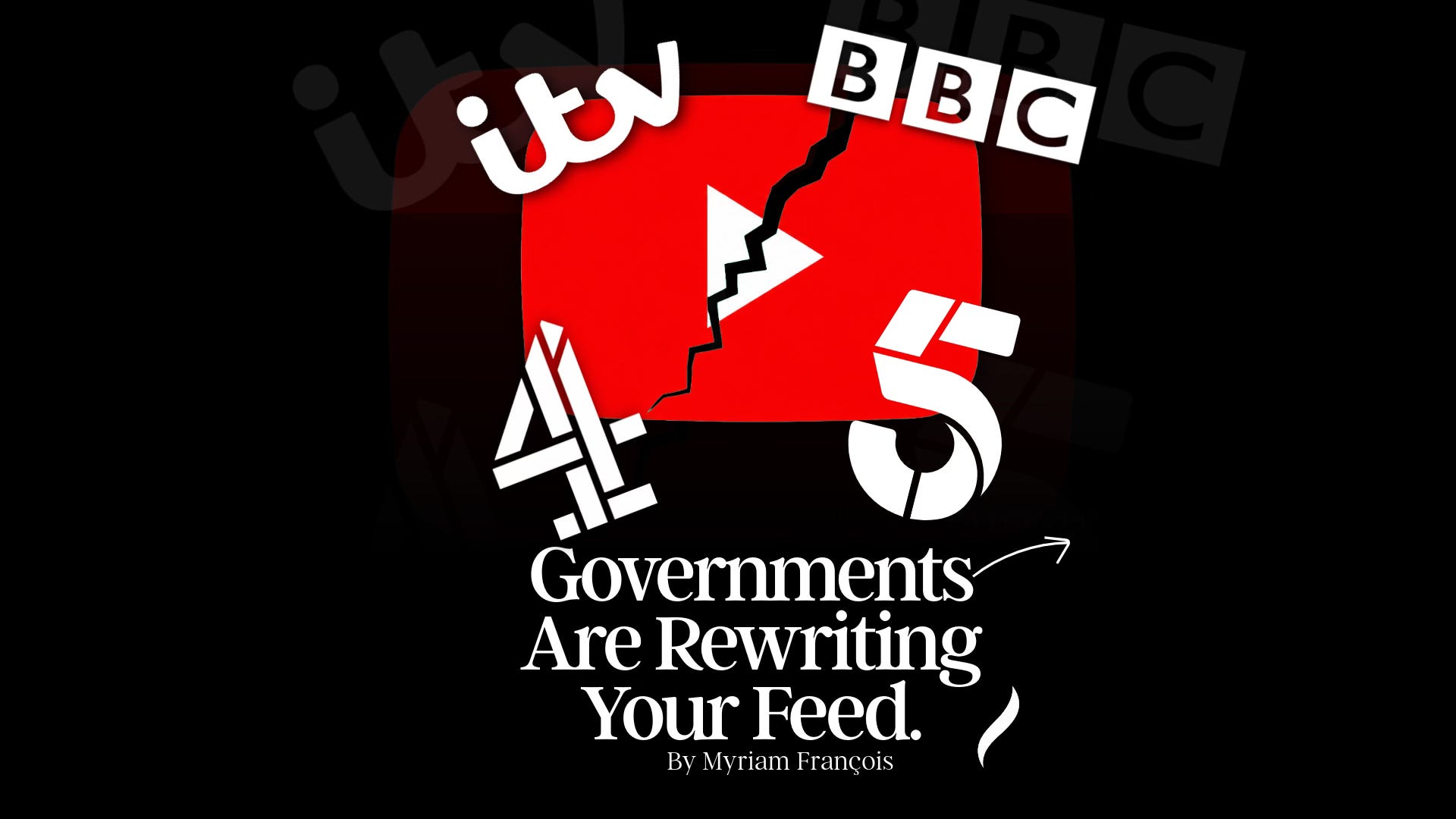
On June 23, the UK’s Department for Culture, Media and Sport published a worrying Green Paper “Watch this space: a new strategic direction for UK media”. In it, it proposed a “prominence regime” for platforms like YouTube and TikTok, whereby platforms would be legally required to rewrite their recommendation algorithms, search results, and home feeds to push content from the BBC, ITV, Channel 4, Channel 5, STV, and S4C to the top. Don’t get me wrong, I think there is huge merit to much of the journalism which has emerged from these channels - but there have also been tremendous documented failings.
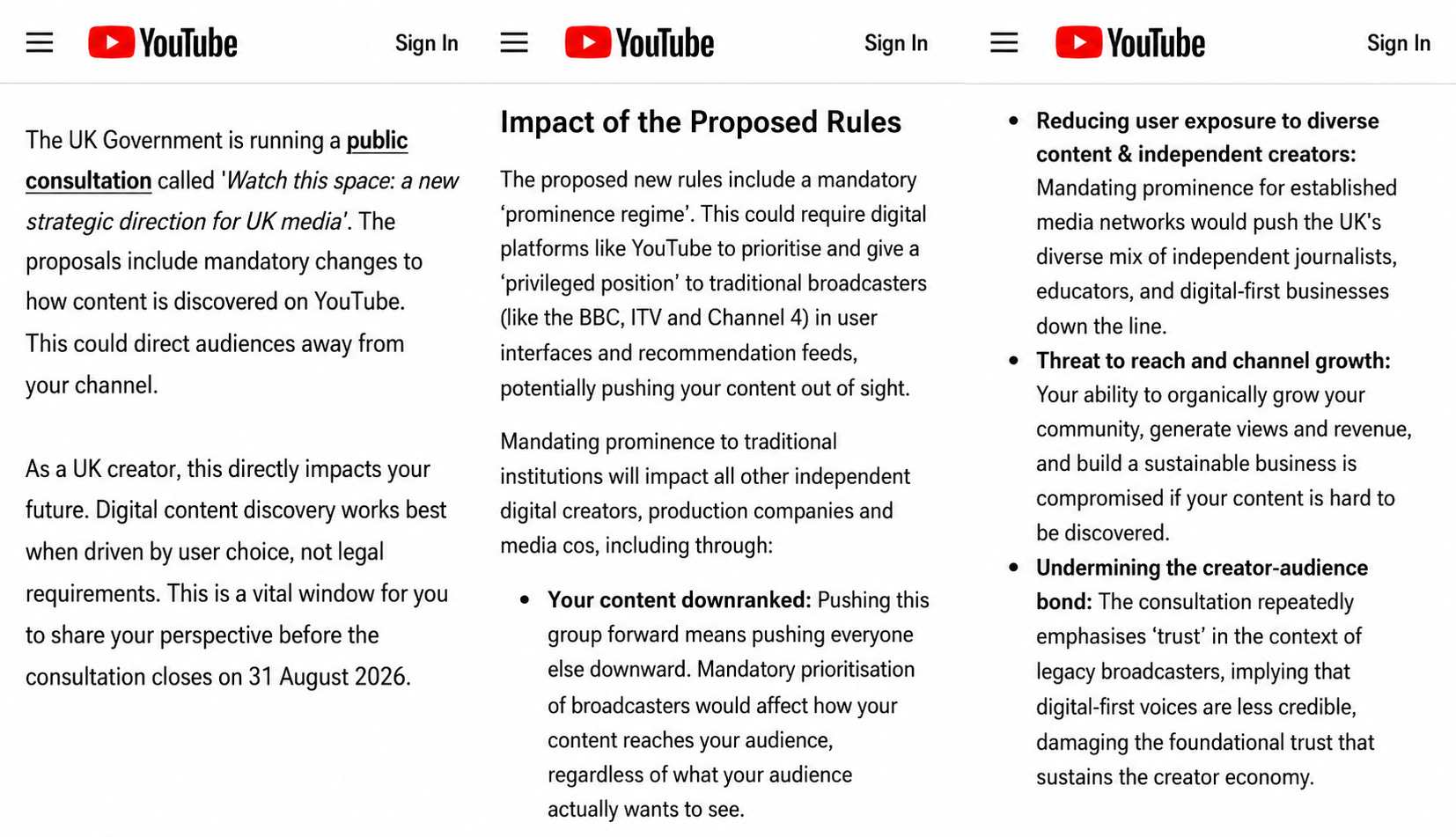
Gaza, Ukraine, and yes, controversially COVID have all shown what happens when governments claim a monopoly on “the truth.” Combine the evidence of these recent legacy media ‘disinformation’ scandals with how close tech companies, far-right movements, and governments have drifted toward one another, and you’ll understand why handing any government the power to decide what counts as acceptable information should alarm us all, whatever you vote.
But sadly the growing control on information doesn’t stop at algorithms. Parliament fast-tracked the National Security (State Threats) Bill, now giving the Home Secretary the power to designate groups as terrorist organizations and criminalise anyone who “supports, assists, or obtains material benefits” from them. Sounds reasonable? Here’s the catch: “material benefit” includes information. Interview a member of a banned group, obtain their leaked documents or quote their internal publications for a story and under this law, you could go to prison. Put plainly, we can’t quote groups the government doesn’t want you to hear from or understand.
The EU followed with its own version. On July 2, the European Court of Justice expanded its interpretation of wartime sanctions to criminalise independent bloggers and ordinary internet users who share clips from sanctioned Russian state outlets — even for reporting or commentary. Digital rights groups call it exactly what it looks like: a backdoor to censorship, dressed up as a trade sanction.
Each of these examples hands control over what the rest of us are allowed to see, say, or share to bodies who think they know what we should be allowed to be exposed to. As with most things, it always starts at the fringes, the groups it is hard to object to seeing censored, those the majority don’t care to hear from anyway. But the precedent is set.
Our promise to you is to continue to dig deep into the information ocean and bring you the gems we think you need to hear. Part of the reason we’ve moved over from YT is to circumvent growing and increasingly blatant shadowbans and demonetisation. But it’s also to connect with you, our community much more directly. We need to find spaces to share concerns, engage in discussion and challenge one another as vested interests seek to keep us all at best distracted and at worst misled.
Our goal at The Tea is to serve you public-service journalism that asks the questions we cant elsewhere and to provide in-depth conversations that treat you as capable of handling complexity.
Which brings me to this week’s episode.
Is AI going to take your job? Enslave you? End the world as you know it? I sat down with Dr. Anne-Marie Imafidon to find out, someone eminently qualified to answer, having been a certified genius since childhood, and someone you might recognize as the human calculator from Countdown. She founded Stemettes, the award-winning UK enterprise getting girls, young women, and non-binary people into STEM careers, and now advises a leading think tank on the future of work.
My team and I use AI every day, to speed things up, to brainstorm. But the sharp insight, the unexpected connection, the idea nobody else saw coming? That still comes from the humans in the room. I wanted to understand, with someone who has spent her career working both with human genius and cutting edge technology, what “intelligence” actually means when we are told we no longer need to think, because machines have a growing grasp of it...
Watch the episode, and tell me what you think.
Warm regards,
Dr Myriam François